

 All photographs →
Choose a photograph, then select it again to enter the project.
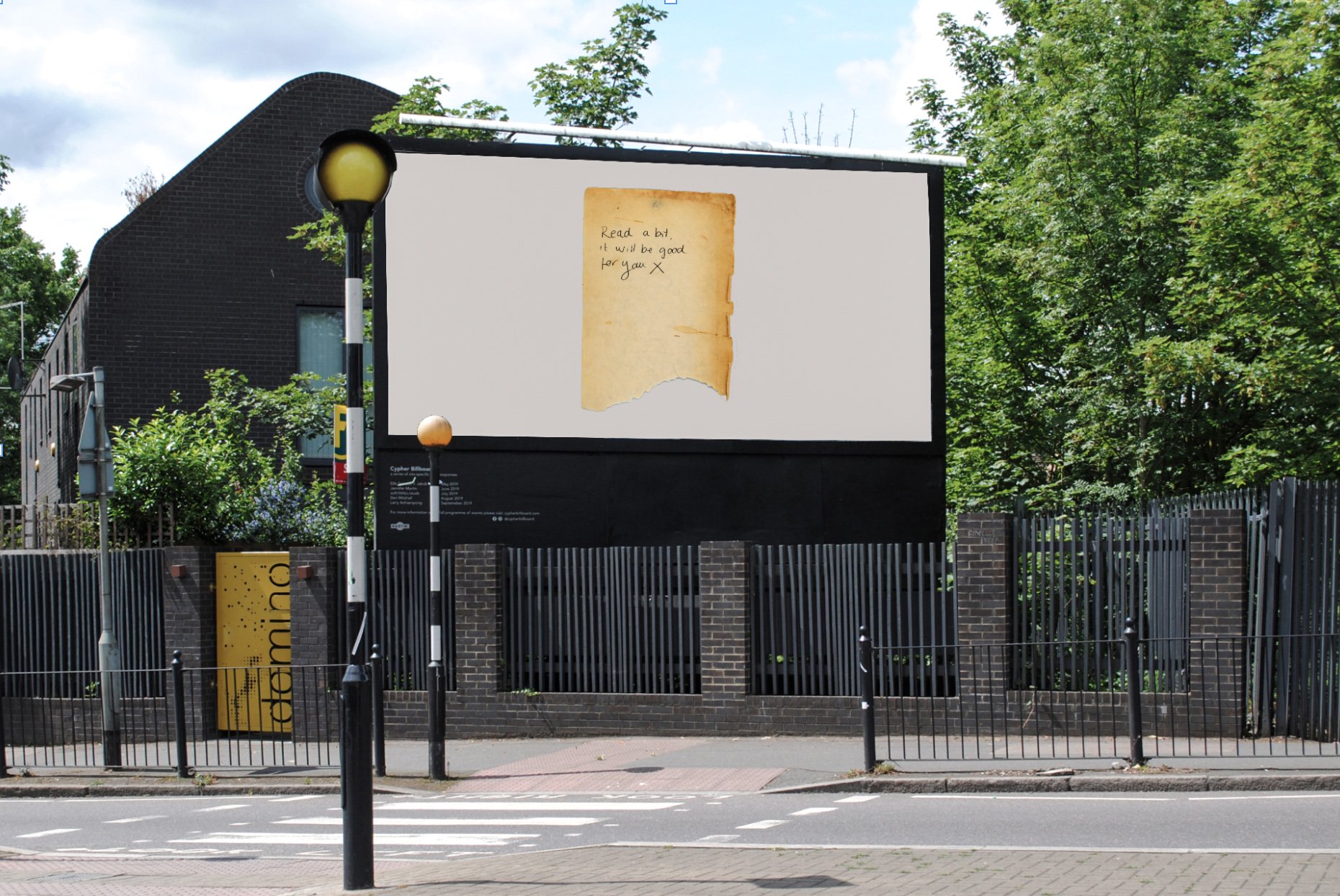
London · 2021
Read a bit, it will be good for you x takes a private note written inside a book and makes it a public invitation. On a billboard, its gentle advice sits where advertising usually asks people to listen and believe that what is being sold will improve their lives. The work questions what those promises leave out: the cost to a person’s own health and wellbeing, or to other people.
CYPHER BILLBOARD commissioned site-specific artworks for a billboard on Bounds Green Road, London. It treated an advertising space as a place to develop art and conversation, with accompanying events and sound. Read a bit, it will be good for you x was made for its 2021 programme.
Essays by John Sweeney, Kate Webster and Alex Saxton extend the invitation into longer acts of reading. The accompanying Sounding Sites: X, made with members of Ismena Collective and recordings from Bounds Green, explores the relationship between reading and listening.
Domino Houses Billboard, Bounds Green Road, London · 10 September–31 October 2021
“Read a bit, It will be good for you”. This sentence breaks two rules of English grammar. The first is that the capitalised “It” should properly follow a full stop, not a comma. The second is that the full stop should sit inside the speech marks, not outside them. Sorry to be a grammar Nazi but I did go to a bloody grammar school.
Read a bit, it will be good for you. I'm looking at my office right now. There is a stack of books as tall as a large dog about Vladimir Putin, because I'm doing something about the little bouncer you should always be afraid of in a Moscow nightclub. There’s another stack of books, the size of a poodle, which I've written. My first book is on top of the stack. It’s called “The Life and Evil Times of Nicolae Ceausescu”, and it’s about how I ended up reporting on the Romanian revolution in 1989 by accident. The title is a bit naff. On reflection, I should have called it “Christmas with the Ceausescus”. They were shot. There’s four reference books, a book of quotations, a Roget’s Thesaurus, my ancient copy of Pears’ Encyclopaedia from way back when, another book of quotations, then my first novel, Elephant Moon, about the war in Burma, and below that, Cold, my thriller about Putin’s Russia, and beneath that my best-selling non-fiction book, Church of Fear about Scientology, the church that likes to wear dark glasses and beneath that “Wayne Rooney: Boots of Gold”, then Church of Fear, translated into Japanese. Pretentious, moi? Jamais.
And also there's a dog versus looking at me and saying, “What the hell are you doing?” There’s books, books, books everywhere. I live in a house with three stories. On the first and second stories behind the staircase, one whole wall is covered in books. So I have probably got 2,500 books here. I've got more in my garage, and I've got more somewhere else.
Cliches may not be original, but they always have some truth to them. Books are the best wallpaper, though to be honest I actually don't like wallpaper. I'm forever fucking mystified by everything that goes wrong in the world, and I don't understand it. But the more books you read, the better chance you've got. The world is less fucking bewildering. And I mean that with a passion.
My favourite books to read are novels. And within novels my favourites are thrillers, because there's something wonderfully exciting about not knowing where the story is going but having to turn the page. When you write a thriller, the same thing happens. My all-time favourite book is The Big Sleep by Raymond Chandler. I read it when I'm scared or worried. I like to reread it because it reminds me of human courage and human dignity in the face of evil and power and money. The writing is superb, taut, precise, like the inside of beautifully crafted watch. It’s been made into a movie with Humphrey Bogart and Lauren Bacall. There are some great lines in it: “You know how to whistle don't you? Just put your lips together and blow.” It's perhaps the best novel about blackmail ever written, set in LA where gambling and gangsters and murder and sex kompromat blackmail ride along with great wealth and moral depravity.
My top five favourite books? So, The Big Sleep, then Darkness at Noon by Arthur Koestler, which is a fantastic story about a world gone mad, about devotion to a mass murdering psychotic called Joseph Stalin. And obviously, at the same time another part of the world, Germany, had gone mad and produced Hitler. My favourite book about Nazi Germany is All alone in Berlin by Hans Faluda, which is a great novel. Then I love 1984 and Animal Farm. But I think my favourite piece of writing by George Orwell is his essay On Shooting An Elephant. My novel Elephant Moon is set in Burma and I love that short story. Fourth favourite novel would probably be To Kill a Mockingbird by Harper Lee, and fifth, because I read it to my kids, would be Going Solo by Roald Dahl. It’s the story of Dahl learning to become a pilot, and then flying hurricanes against the Luftwaffe, him crashing and being picked up. He writes so beautifully, so funny. But he had a dark streak. He was horribly anti-semitic. His family recently apologised for Dahl’s anti-semitism and good on them.
Nonfiction is often a bit boring. One of the great joys of going to university was the realisation that an awful lot of academic life is boring and pretentious and dull. But every now and then you came across people who really thought in an interesting way and I can remember their minds rang like a bell. So, yes, I went to university and yes, I picked up a degree in drinking. And I can remember doing a bit of philosophy in my first term. My lovely philosophy professor was a guy called Wolfgang von Leyden. Back in 1938 he was a German Jew teaching at the University of Vienna and he was kicked out and by the Nazis. He came back in 45 and said, “As I was saying, before, I was so wudely interrupted.” I loved the cast of his mind.
I hoard books in a way that I don't really hoard much else. I'm not that interested in possessions. But I want to get a bigger house or another house because I've got too many books. I really don't want to throw them away. But the thing about books is that they are beautiful. And they're like people, but you can you can't keep people locked up in your home, but you can keep a book. For me, a really good book is a lovely character. I've got two Kindles, but I never charge them, and I don't really use them. And there's a reason for that, in that a good book has its own smell. I love reading in the bath. And that joy you get from doing that, from the crumpled pages if you get the book a bit wet, that, for me, is like laughter lines in the face of a much-loved friend.
I love from the smell and flavour of a book. It's beautiful, beautiful. And there's another thing too. Armed with books, you can take on the world. With this great wall of books that I've got, I am defended, not just me but my family and my friends. And pretty much everything I believe in is defended by books. I'm thinking about the defence of liberty, of our democracy, of our way of life, of free speech. And for me, I think my favourite book on that is On Liberty by John Stuart Mill. The thing is the elegance of the sentences are not accidental. He put an incredible amount of thought into thinking cleanly, clearly. And you can't do that if you think in a fuzzy or foolish way, your mind doesn't ring like a bell. Your book doesn't shine.
I'm not a fan of Chomsky because I find him pretty fucking unreadable. It's too dense. It's too confusing. But people who write well, they put time and effort into it. George Orwell is a great case. So to develop the thought, books help you deal with and defend yourself against the ferocity of stupidity, which is, and has always been with us, but is with us now, exacerbated and accelerated like petrol on the flames by social media. So what's incredible and beautiful about books is that they are a defensive wall, around what I like to think of as civilization.
You may say that's a pretty, pretty wild claim. But nevertheless, I've got some books on philosophy, I've kind of knocked around with some of the early Stoics and Cynics. Diogenes the Cynic lived in a barrel. And when Alexander the Great, the ruler of the known world, came to see him, Diogenes looked up and he said, “Get out of my light.” I love that story. And I love Bertrand Russell’s History of Western Philosophy.
Books stand on the shoulders of other books that have gone before. I'm looking at my own book about Scientology, The Church of Fear. That rests on a great book by Professor Robert Lifton, an American military psychiatrist who wrote a book “Thought Reform and the Psychology of Totalism: A Study of 'Brainwashing' in China.” The thriller writer Richard Condon read that and wrote “The Manchurian Candidate” about a returning American soldier from the Korean war who had been brainwashed who has a good chance of becoming President of the United States. That was made into a film twice and then an Israeli TV series, with the Chinese Commies being replaced by Hizbollah, and then that was reversioned into the US TV series Homeland which just goes to show there are only so many plots going around in Hollywood.
By the way, you don’t have to agree with me that books are the only possessions worth having. But if you disagree with me, watch out. The people who thought burning books was a good idea ended up surrounded by rubble in 1945.
@johnsweeneyroar on twitter
I write to you, to myself, to my soul’s reflection in another. For now, and for never: forever.
***
I’m sure that you read all the time. Your eyes are glued to your tiny hand computer. A glowing pool where, gazing upon my reflection, you see the lines on your forehead reflecting back at you.
You wasted your loveliness on me. I’ll be your best friend.
You see my pictures and read my messages and make meaning from the shapes of the letters and order of the words. And it’s quiet. And it’s ours. And it’s something for us to say together in secret and forever.
Who “us”? US us?
Yes, us. Me and you.
That’s the rub: the wound that Roland spoke of in looking. Stranger or soulmate that may never have been and may not ever be except in the text, and in this moment. (I’m already dead, so happy birthday to you!)
***
We know who we are through the stories we hear: the ones we tell ourselves and each other, the ones we gravitate to or our memories omit. We read what we see around us: where to go, how to look, what to buy, how to feel - the fleeting messages and dopamine bursts that flash and refresh but don’t stay with us deeply and pierce us (we hope).
When we are small, we know who we are through the stories we are told with books at bedtime: big bad wolves, hoppers and ants, and flexible reeds that do not break but bend. We listen and learn and repeat and repeat as a grown-up lovingly, patiently, lets us, with chubby fingers, tear or turn the page. We hear the sounds that match the pictures until we know the stories by heart; the stories that tug on the heartstrings of grown-ups when, in time, they recall reading them to their no-longer-small children. If we are lucky.
It’s linear, it’s logical, learning the sounds that turn into stories when they correspond to pictures. Next, abstractly, we learn the sounds that turn into stories when they correspond to strange lines on a page. We learn why lines and curves shaped this way make this sound and those going that way make that one. We read aloud, and sound it out: this or that not tis or tat or his or hat. That his and this do not rhyme (sound that out). We need rules to govern this arbitrary and communally agreed upon nonsense! An adjective modifies a noun, but written differently, an adverb, it modifies an adjective, a verb, or another adverb - and don’t get them confused! Your subject and your verb must agree (you fool!) unless you know the rules so well that you may break them. Toward school with heavy looks we go, laden with rules to perform for our classmates the task of reading aloud.
Some of us, at curtain, discover the solace of reading alone. With stage fright abandoned, fawn-like, we stumble through chapter books and fantasy and magic and poetry. Perhaps you retreated, hot cheeked, from reading and haven’t looked back. I hope you found your solace somewhere. Witnessless reading is wonderful.
The next step is research and reading dense material for fact finding, analysis, and dissection. The formaldehyde hangs in the air as I pin back the skin cut by a scalpel. I hide my solace where the smell won’t find it.
Essays, book reports, research papers: reading gives us truth. We demonstrate our reasoning with citations and bibliographies that what we have read is real and true, so what we are sharing must also be true and real. We present words and letters like mathematical proofs.
Next, we are anointed and offered the secrets of how to decode our reading for music, for intention, scanning syllables for rhythm and emphasis where different combinations have names like dinosaurs, with names for words and groups of words that build meaning and muscle onto skeletal -oses like myth, eth, and log.
For some of us, this science feels good. There is a joy in knowing how to dissect the combinations, the blood, the guts, the chemistry of why it feels beautiful to hear so long lives this, and this gives life to thee. The pull of prose whose arachnid architecture satisfies like weaving a tail of yarn back into the seam.
From control to surrender, perhaps it’s the magic, psilosybic means of seeing without sight, smelling past perfume, and clay, and dust, and history. Abandoning rules and science, Roman scribbles turn to color to the temporary synaesthete. In silence, the beat of the wording throbs. You surrender to story, one I control, and my fingertips brush the folds of your brain. I place words on your lips, where, held in your mouth, they taste like the watchband still warm from my wrist. Like your heart on my cheek when you slept in my bed and I loved you. I reach across an ocean, the plains, a century: a global village of two. It’s never and it’s now. To read is to wander while Penelope, faithful, the words stay the same.
Perhaps you can smell Pacific salt in the air from where you are reading. Be with me and breathe in California—!
Despite knowing better, we trust what we read. It’s fact-checked, it’s proved. If it’s written, it’s right. If it’s published, it’s verified, it’s true and it stays, to be referred to through time, unlike speech, unlike memory which evaporates, ephemeral, and liable to disbelief. To forgetting.
(A traitor once told me recalling a memory, we only remember the last time we recalled it. The memory itself floats farther and farther away. If it’s true, then our memories of dreams and novels and truth become the same collection of reproduced impressions to recall and recall and recall. They say you’ll go blind that way. Perhaps that’s the point.)
Sometimes when we read, we get the truest truth: the honesty we see only rarely in Pastis moonlight with pupils unmet. The most intimate pleasure where your thoughts meet my thoughts. Missives sent through sadness or secret. Wet, animal, alive. You confess your desires under serifed shroud. When Bibles came home - imagine the scandal! The secrets of God on your lips.
The confession is pleasing. A secret smile curls as you read, in awe, the despicable and poetic filth. The violence. The darkest acts unfold and bleed ink on the page and in your image, and you keep reading. Keep turning the page. Le bébé est mort, but how could she kill him? Why do you like her? When you shiver knowing you will feel what she feels, do you like the feeling? Do you fear familiarity with Adam’s Cathy and Bianca’s sister? The voyeuristic embodiment of your lowest self. Of lying and spying, of cheating and stealing thatyou would never feel in life. (Or maybe I lie after years of being so good as a balance. When does this silent sound turn to fiction?)
And you return to us in this condition—!
You recognize the worst of you in them: the most hidden, crumpled, pushed away shame that you thought was only yours. A quiver that makes you alive and exposed. The ego! You are not special. There is humility in seeing your feelings are not unique. Your ennui, homesickness, jubilance, your heartache: it is not your own. It is shared with at least one other, an epistolary confessor who named it in ink so precisely today or many hundreds of years before. The sweet relief that you are not alone. The sightless riddle and wisdom in recognizing that together we are Nobody. The word on the page is both proof of something and of nothing: an intimateconspiracy to anchor our projections, perceptions, and pasts. Be it book, or screen, or warm phone in place of your hand in mine, palm to palm in holy palmers’ kiss, to read is to share our most intimate moments. Humility meets hubris. You feel what I feel; I feel what you do. So, read a bit. It will be good for you x
When describing the epiphanic moment he began to read, and his subsequent transformation from an illiterate convict, into a highly articulate, world-famous human rights activist, Malcolm X said “Anyone who has read a great deal can imagine the new world that opened”. Malcolm X taught himself to read in prison by copying every single word in the dictionary. He became fiendishly addicted to the written word, reading non-stop in a dimly lit cell, and even ruined his eyes, earning his trademark Browline glasses in the process. Once the penny had dropped, and he discovered the joy and rewarding beauty of reading, he never looked back, and dedicated every available second of his remaining prison sentence to reading. When Malcolm X served his time and was released, his leadership and power as an orator changed the world. Although he lived a short life, for Malcolm X, reading, and the pursuit of knowledge, was a life-long passion. Like Malcolm X, I fundamentally believe that reading is an artform which is good for mind, soul and body, and can be pursued for life.
I have always felt that people who read are in on a secret. If you ask someone who does not read much to speak on a book they have read, you will probably be met with bemused shrugs. But if you ask someone who reads a lot the exact same thing, their eyes will flash up with excitement, and they will begin to exhort passionately, maybe even for hours at a time. In fact, someone who loves reading will be able to speak passionately on a book that they did not even enjoy, precisely because they have acquired the skill of critical thinking through reading so much. If you have read a lot of incredible, life-changing literature, books which do not evoke the same feeling are easily identifiable.
Perhaps if you have not become addicted to reading, you have simply not found the books which speak directly to you yet, but they are out there. Or maybe this is my own bias, being someone who has seen what Malcolm X saw in reading, perhaps not everybody will. However, I truly believe there is something universal in the way reading can be used as a tool to better ourselves. When you find the literature or the writers that you truly relate to, it is beautiful. Reading can transform the way you think, and see the world. After all, is it not logical that exposing your mind to information you were previously unaware of, might make you more philosophical, expand your perspective, and ultimately alter your consciousness in an elevated and more enlightened way?
The father of western philosophy Socrates, claimed no personal credit for the knowledge he held, saying he only knew more than others because he knew that he knew nothing. Socrates’ awareness of the limits of human perception meant he instead saw himself as the midwife of intellect, one who merely guided his students towards the innate knowledge that they were already in possession of. To Socrates, the mind was infinite in nature and potentially held the entirety of the universe within it. Knowledge was simply a matter of reclaiming what you already knew but hadn’t been shown yet.
And so, it is for reading. Reading activates this innate knowledge within ourselves. We cannot put the entire contents of every library in the world into our mind because we simply will not have sufficient time in our short lives. But we can open any book in any library and start activating the knowledge our mind has made us innately capable of comprehending. To be blunt, we will die way before we could read *every* book, but we can read *any* book we like, and expand our minds in any way we choose. You are not a Quantum Physicist because you have not studied Quantum Physics, not because Quantum Physics is something beyond your comprehension. Just beginning to read opens a never-ending world of knowledge to you because you can do anything.
And yet Socrates is often associated with scepticism. Scepticism is essentially the idea that we must question the validity of what we encounter, not simply accepting all that we are told unquestioningly, like children. And this is the same with reading. Even fiction contains elements of the truth, and will always reveal the attitudes of the writer. We can find literature which has been read for generations awe-inspiring and mesmerising. It is remarkable to think of Robinson Crusoe being read throughout many different centuries yet still retaining an enduring message, at any point in time to those that opened its pages. When we begin to read a lot, we develop critical skills and begin to question not only what is written, but also the motives of why something was written, who by and to what end? Therefore, it is very important to be highly analytical with what we choose to read, as well as being selective with what we read in the first place. Reading in general can be good for you, being selective and focused with what we read, can be wholly transformative, for mind, soul, and body.
If something is still being read thousands of years after it was written, it is almost certainly because it has, and continues to, enrich those who read it. The entire tradition of western philosophy has been dismissed (and perhaps somewhat convincingly) as ‘footnotes to Plato’. In the sense that no idea is original, or in the same way that Isaac Newton attributed the progress he made in mathematics to ‘standing on the shoulders of giants’, reading reminds us that knowledge is never a question of ownership and is always dependent on what came before it. All we can do is elaborate upon or add nuance to, what has already been said in the past, much less claim personal credit for the common experience of mankind. Reading reminds us that even the greatest writers humanity has ever produced, like Shakespeare, have always been borrowing from, and limited by, the historical constraints of their time. Even the most celebrated books have only synthesised and blended parts of the knowledge of the time they wrote in. But when the knowledge of the ancients is still being read to this day, it is probably for a good reason, and I think we should try to read it for ourselves if we can. This is not in order to blindly agree with its content, but to analyse it, and see what speaks to us and what does not.
Literature which has survived this long is mind boggling and incredible. I believe at a certain point the ideas which are contained in writings that have been read for thousands of years go beyond cultural, religious or in-group and tribal sensibilities and make a genuine contribution to civilization, by that I mean, the combined experience and advancement of all humanity. Some literature has improved the quality of human life on earth for those that read it, regardless of political or cultural biases, and has been preserved for that reason. ‘The Meditations’ of Marcus Aurelius might have been lost, were it not for the Vatican library, despite the fact that Aurelius’s Stoic creed could largely be considered heresy to the Roman Catholic church. Or Avicenna, the 10th century Arabian scholar, who is credited with keeping the works of Plato and Aristotle in circulation, despite there perhaps seeming to be a slight contradiction between the logical findings of Islam and Classical Greece. Knowledge is power, and regardless of our personal, religious or cultural loyalties this has always been the case throughout the ages. Reading really will empower you.
Reading is an artform which is good for you. It is not an exaggeration to say reading is a dying art. Reading requires effort but it is hugely rewarding. Reading is an incremental process, you really do only need to read a bit and it will be good for you, bit by bit. Like any art you will not instantly be good at it. You cannot instantly master an artform without persistence. Reading can be daunting, and the sheer size of some books can put you off ever attempting to read them in the first place. Les Miserables, and War and Peace, for instance, are both mammoth books. But when you break it down, they are both written in sections and amount to the equivalent of reading about four short novels, that psychologically at least, it would be a lot easier to approach for someone who is unaccustomed to reading regularly. Reading takes discipline, but conversely it is something one might do when relaxing. However, even strenuous physical exercise can be to some extent relaxing for someone who has gotten used to their specific routine. Reading requires deep concentration and awareness of what you are engaging with. For all of these and many more reasons a lot of people are not readers, in the same way that not everybody regularly exercises. Reading can simply be too time consuming for many people to be featured in a daily routine. Putting in the hours which reading necessarily requires, is not possible for everybody.
That being said, the nature of the media and marketing mean people do in fact read every day, even if they are not fully focused on what they are reading. Key words or phrases in adverts penetrate our thoughts subconsciously. Modern advertising is said to play upon our unconscious desires. By projecting the consumers psychological insecurities upon themselves, advertising finds ways of selling the consumer superfluous and trivial items. Adverts themselves are often designed to make consumers feel they lack something on a moral or even ethical level. Alduous Huxley said, “You can’t consume much if you sit still and read books”, in this way reading can be anti-consumerist. Instead of consuming food and drink or material items, when you read, you consume ideas. Reading is a very time consuming, and personal process, which some may see as anti-social, and to some extent it necessarily entails a disengagement with the systems propaganda. You aren’t reading the high streets billboards or your smart phones flashing adverts when you read books. Classic literature can also be acquired very cheaply, with a library membership or in charity shops for example. Books are an affordable and humble habit in comparison to a great many of modern society’s vices. Reading may keep you out of trouble! Reading is similar to, or even a form of, meditation, as it is a personal ritual undertaken in silence, features it very much shares with praying as well.
Why read a physical book and have to go to all the effort of turning actual pages, when you can read a kindle? Why read an entire article when you can simply read its headline? We live in an age of tablets and click bait, where the skill of reading a map, is being replaced by just mindlessly following GPS systems, and tapping apps. In the information age if you don’t know something you simply “google it”. Perhaps the reading of books is becoming outmoded. Donald Trump has been described by some as the first President of the post-literate age. When asked to name his favourite book, Trump somewhat vaguely said ‘The Bible’ but was of course unable to name one verse when prodded. For me there couldn’t be a much better argument in favour of the universal benefit of reading than resisting this so-called post-literate age. Who wants to become a mindless automaton more engaged with their smart phone than their own inner core? So read a bit, it will be good for you!
Author’s emailed final draft · 1 September 2021